
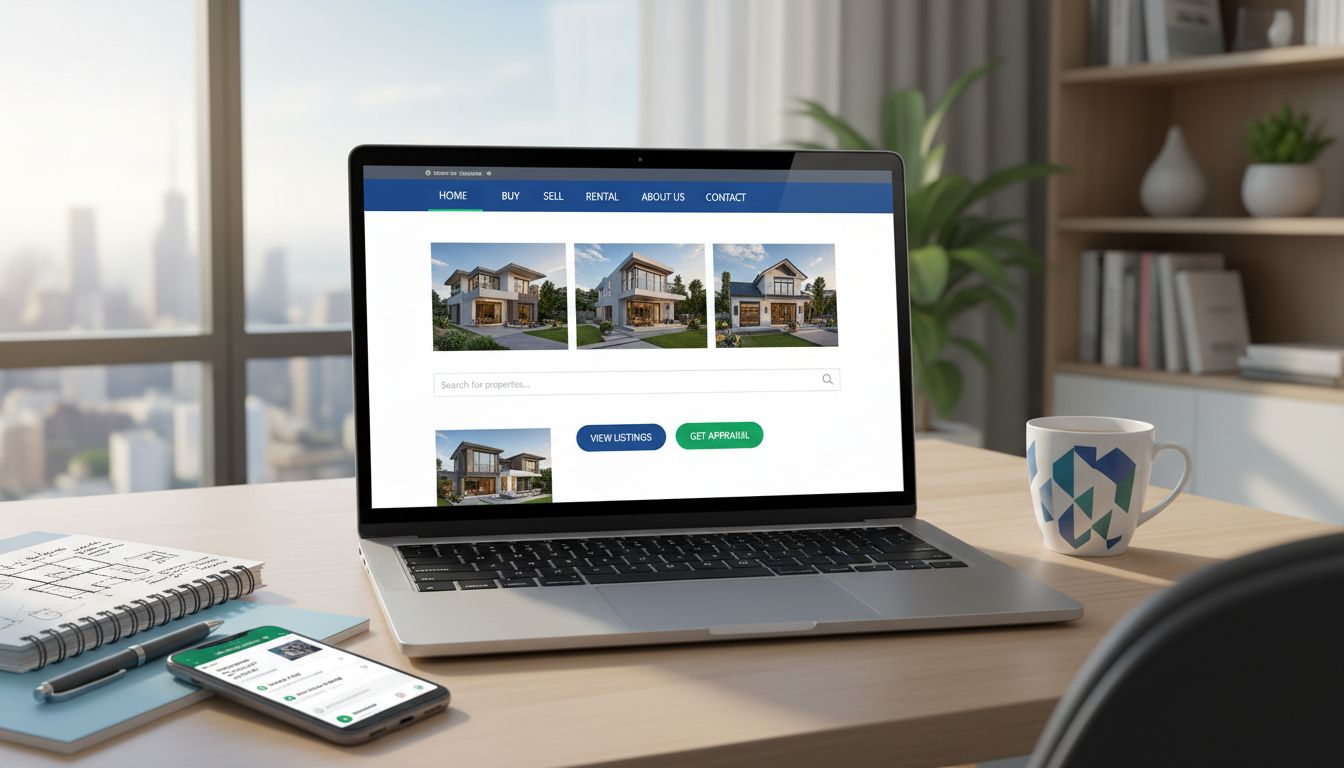
Real estate website design should not feel like a side project you keep meaning to get to.
Your online presence should be the machine that quietly brings you new leads while you are at open houses, in the car, or asleep.
If your current site feels more like a digital brochure than a sales engine, that needs to change.
Table Of Contents:
- The Core Ingredients of a High-Converting Real Estate Website Design
- IDX, Search, and Making Listings Actually Work for You
- Lead Capture That Feels Natural, Not Needy
- Content and Media That Make People Stay Longer
- Choosing The Right Platform for Your Growth
- Planning Your Own Real Estate Website Design
- Conclusion
The Core Ingredients of a High-Converting Real Estate Website Design
You do not need a flashy concept site to impress your audience.
You need something that loads fast, is clear, and helps visitors move one step closer to working with you.
Think less art piece, more hard-working digital agent.
Make It Easy for People to Use Your Site
Most agents secretly build their site for other agents.
Nice hero image, cool logo, some local awards, maybe a drone shot over the city.
But your buyers and sellers have very different needs.
The average age of a home seller sits around 63.
That should instantly change how you think about fonts, contrast, and layout.
If your text is tiny or light grey, you are quietly asking your most valuable clients to work harder than they should.
Good user experience design means your menu is clear, your buttons are obvious, and the important actions are never buried.
Your site should make it stupidly simple to search listings, book an appraisal, or get in touch.
Every extra click loses a slice of traffic.
Consider the expectations set by modern mobile apps.
Users want that same smooth, intuitive flow when they visit your website.
Your phone number must be clickable and visible on every single page.
If any one of those fails, people will leave even if your content is strong.
Your competitors then get the lead you paid for.
Great experience design keeps people engaged longer.
| UX Element | What It Should Do |
|---|---|
| Navigation | Help people find listings and contact options in one click. |
| Fonts and contrast | Stay large and clear enough for older eyes. |
| Buttons | Looks like obvious actions, not decorations. |
| Page speed | Load quickly on average mobile data. |
| Mobile apps feel | Respond perfectly to touch screens and swipes. |
Think Like a Buyer, Design for a Seller
The awkward truth is that buyers mainly want search tools, and sellers mainly want proof that you get results.
Your site has to do both, without feeling like a maze.
This is where structure matters more than visual flair.
Think about the first scroll on your home page.
Does someone see your market focus, current listings, social proof, and an obvious call to chat?
Or do they see a slideshow of pretty buildings with no clear next step?
When you sell houses, your website acts as a 24/7 open home.
Effective real estate website designs balance the needs of both sides of the transaction.
It helps you attract potential buyers while validating your skills to vendors.

IDX, Search, and Making Listings Actually Work for You
You probably have some form of IDX or feed-driven listings on your current site.
Yet many agent sites treat IDX like a dusty corner of the site, not the engine room.
The design around those listings decides how much value you get from them.
Turn IDX Into a Search Experience People Enjoy
Your search should be faster and easier than the big portals for the patch you care about.
If buyers find your site hard to use, they bounce straight back to the big players.
Then you are just handing them warm traffic.
Consider your market boundaries and niche.
Are you building for one neighbourhood, a whole city, or downsizers across regions?
People may be browsing your site from interstate, with no clue about your local quirks.
Smart filters like school zones, commute times, or walk scores make your site feel tuned to their worries.
It turns bland IDX data into a useful search experience.
Proper IDX integration allows for a seamless transition between your content and the data feed.
Many real estate website builders offer basic search, but you want advanced filtering.
A robust property search keeps users on your site longer, which signals value to the search engine.
Use Listing Pages as Silent Listing Presentations
A listing page is not just there to show photos and a price guide.
It is your quiet pitch to the next potential vendor who is comparing agents.
Every listing they see on your site answers a hidden question.
“Would I trust this agent to sell my place for a strong price?”
So treat listing pages like a mini case study in good marketing.
Use clean, consistent image sizes, clear headings, and floor plans that are easy to see on mobile.
Adding 3D walkthroughs and virtual tours can lift your perceived value in seconds.
Even if some visitors do not watch the whole thing, the presence of a tour sends a clear signal that you market your property well.
Strong visuals and calm layouts make the experience feel premium.
You can adapt that vibe to your brand without needing skyscraper-level budgets.
This attention to detail is vital in luxury real estate.
High-end property listings demand high-end presentation.
Great real estate website designs elevate the perceived value of every home you represent.

Lead Capture That Feels Natural, Not Needy
Plenty of real estate sites get traffic but almost no enquiries.
The content is there, the listings are there, yet the inbox is quiet.
Usually, the gap is simple.
There are not enough easy, low-friction ways to put a hand up.
Or the site asks for commitment too early with heavy forms that scare people off.
Your real estate website design has to balance both.
Layer Your Calls to Action
Think of your visitors in three groups: ready to talk today, curious but shy, and early browsers doing research.
You need offers for all three groups spread across the site.
For the first group, you want strong actions like “Book an appraisal” or “Request a strategy session.”
These work well at the top of the home page and on service pages.
For the second and third groups, you need lighter options.
Think about email newsletters, suburb reports, and property alerts.
Make your sign-up flow fast and clean.
Keep the form to first name, email, and maybe one suburb.
You can qualify them later through automation and conversation.
Do not hide your email signup at the very bottom of one page.
Add it under blog posts, in the sidebar, and on listing pages for buyers who want new stock fast.
You are trying to start low-pressure relationships, not ask for marriage on the first date.
Effective lead capture tools are subtle but persistent.
The best tools capture interest without annoying the user.
Use short lead capture forms to minimise friction.
Connect Your Website With Email and Follow Up
Many agents pour effort into real estate social content, yet their database growth is stuck.
Often, the issue is that traffic flows in, reads a post, and then wanders away.
Your site needs to channel that interest into an owned list.
Tools such as the real estate email marketing templates are helpful once people are in your database.
But you first need clear paths from each page to a relevant offer.
For example, add a banner on every “Selling” article for your pre-listing guide or local price report.
If your practice touches on more legal or process-heavy sides, even something like a short explanation page inspired by a real estate purchase process guide can build trust.
Use those pages to both educate and invite contact.
You are giving real value while gently reminding visitors that it is easier to let you handle the work.
Integrating a built-in CRM allows you to track these interactions.
This transforms raw data into qualified leads.
Automating this flow is essential for modern lead gen.
Content and Media That Make People Stay Longer
Design alone will not carry a weak site.
You need useful content and strong media baked in from day one.
This is where many templated sites fall flat.
Use Video Where It Matters Most
Adding video can feel like another job on an already long list.
But there is a good reason to care.
Websites with video are more likely to show up in search results.
You do not need cinema-grade production.
A simple market wrap, suburb overview, or agent intro recorded with a decent phone can work well.
Just keep it steady, clear, and honest.
Place your video where it can shift trust.
Your About page, your home page, and high-intent landing pages are great spots.
Videos make your site more visually appealing and engaging.
They help elevate brand perception significantly.
Plus, video content is highly shareable on social media.
Choosing The Right Platform for Your Growth
The technology you choose to build on matters as much as the design itself.
There are many popular choices available to modern agents.
Your choice depends on your budget, technical skill, and growth goals.
Some agents prefer all-in-one website builders that are easy to manage.
Others hire professional graphic designers for a completely custom look.
Specialised real estate website builders often bridge this gap effectively.
A tool like Agent Pro might offer specific features for individual producers.
Meanwhile, standard website templates from general builders might require more customisation work.
When selecting a vendor, check if they offer IDX websites out of the box.
Ask about their capabilities for capturing leads and integrating with third-party tools.
You want a partner that understands the real estate business, not just generic web code.
Planning Your Own Real Estate Website Design
Before you jump into themes or colours, pause for a moment.
The most expensive mistake agents make is designing before deciding what the site is supposed to do.
A beautiful site with no clear strategy is just a very fancy business card.
Grab a page and map out three things.
Who you most want to reach, what actions you want them to take, and what proof you can show.
Everything in your site plan should feed those three points.
- Write down your top markets and client types.
- List the three main actions you want people to take.
- Collect proof like results, testimonials, and media mentions.
- Choose the pages you really need, not every page you could add.
- Plan where each call to action and each proof piece will sit.
Then, and only then, move into layout and design choices.
This alone will put you ahead of most competitors.
It creates a site that naturally generates leads.
This planning phase helps you create a great design that converts.
It ensures you build a platform for lead generation rather than vanity.
Ultimately, this preparation helps you secure more seller leads.
Conclusion
Good real estate website design is less about pixels and more about the path you lay out for a stranger who is thinking about a very big decision.
Your future sellers and buyers are checking how easy you are to deal with long before they walk into your office.
Your site quietly answers that question for them.
By focusing on clean UX, stronger IDX experiences, and thoughtful lead capture, you turn your site into a consistent source of conversations instead of a static brochure.
You can lean on proven tools, data, and examples from top real estate agents and major developments while still sounding like a human from your own neighbourhood.
If you treat real estate website design as a live part of your business, not a one-off task, it will keep working for you long after your latest listing is gone from the front page.