

Your website is live. It’s got your name, a few listings, maybe even a contact form. So why does it feel like nothing’s happening?
No leads. No inquiries. No new listings.
Just digital silence.
You’re not alone. Thousands of real estate agents pour time and money into their online presence, only to feel like they’re shouting into the void. The truth is, it’s not that your website is broken, it’s just not built to convert.
And let’s be real: you’re already busy enough juggling showings, client calls, and market updates. Fixing your website shouldn’t be another full-time job. But if your site isn’t helping you land more listings, it’s quietly costing you opportunities every single day.
In this guide, we’ll show you:
- The real reason most real estate websites don’t generate leads
- 5 common mistakes that are turning visitors away
- A step-by-step fix to turn your site into a client-generating machine
- How modern agents are showing up everywhere without touching a keyboard
You don’t need a flashier design. You need a smarter strategy, one that works while you work.
Let’s break it down.
The Real Reason Your Website Isn’t Getting You Listings
It’s Not Broken. It’s Just Built Backward.

Here’s the thing no one tells you: most agent websites weren’t built to bring in listings. They were built to look like you have a website.
And there’s a big difference.
It’s not your fault the industry has been flooded with plug-and-play templates, DIY site builders, and one-size-fits-all platforms. They promise quick results, but what you end up with is a digital business card. It looks fine, sure. But it doesn’t do anything.
- No lead magnets.
- No content strategy.
- No path from “just browsing” to “ready to list.”
In other words: your website isn’t broken. It’s just backward designed to show information, not generate action.
If you’ve ever looked at your site and thought,
“Why isn’t this doing more?”
…you’re asking the right question.
Brochure Sites vs. Lead-Generating Sites
Let’s break it down:
|
Brochure Website |
Lead-Generating Website |
|
Static homepage with bio and listings |
Dynamic, CTA-driven layout |
|
Focuses on you (agent bio, awards) |
Focuses on them (what buyers/sellers need) |
|
Few updates, no blog or SEO strategy |
Regular, search-optimized content |
|
Passive language (“Contact me”) |
Active funnels (“Get your free home value report”) |
|
Generic design & template feel |
Customized to your niche and market |
Most real estate agents start with a brochure site because it’s easy and familiar. But these sites don’t guide a visitor anywhere they hope someone fills out a contact form. And hope, unfortunately, isn’t a strategy.
If you want your site to bring in listings, it needs to be designed for conversion, visibility, and trust, not just curb appeal.
5 Website Mistakes That Cost You Listings
You’ve got the license, the drive, the hustle but if your site is making these mistakes, it’s likely working against you, not for you.
Here are the five most common reasons real estate websites fail to convert and what to do instead.
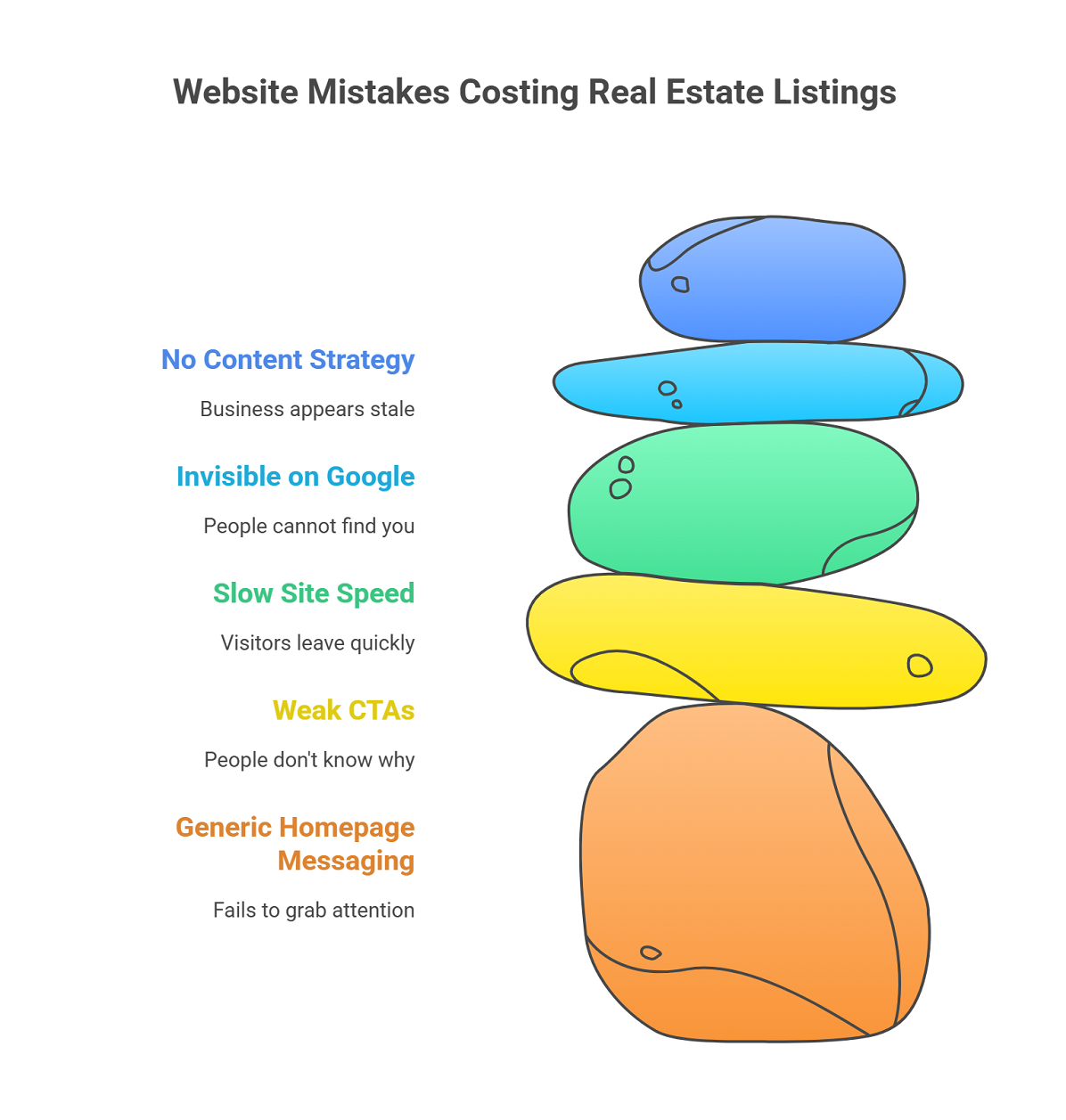
Mistake #1: Generic Homepage Messaging
Most agent websites open with some version of:
“Welcome! I help buyers and sellers in [City Name] find their dream home.”
It’s polite. Safe. Professional.
And completely forgettable.
Your homepage is prime real estate. If you don’t grab attention in the first 3 seconds, most visitors are gone, especially sellers who are scanning to see if you’re the agent for them.
Fix it:
- Speak directly to your niche: “Helping first-time sellers in Melbourne get top dollar without the overwhelm.”
- Lead with clarity, not fluff.
- Show proof or results immediately (e.g., “98% list-to-sale price ratio”).
Your website isn’t a brochure. It’s a pitch and you’re not just selling homes. You’re selling trust.
Mistake #2: Weak or Missing CTAs
“Contact me.”
“Get in touch.”
“Let’s connect.”
These passive calls to action are like open doors without signs people can walk in, but most won’t know why they should.
Fix it:
- Use strong, specific CTAs:
→ “Get your free home valuation”
→ “See what your neighbor’s home sold for”
→ “Download our 5-step selling checklist” - Repeat CTAs throughout your pages and don’t hide them in the footer.
People need direction, not just access.
Mistake #3: Slow Site Speed and Bad Mobile UX
More than 60% of homebuyers and sellers browse listings on mobile. If your site takes more than 3 seconds to load, they’re gone.
And if it’s clunky on a phone? Forget it.
Fix it:
- Test your site’s speed on PageSpeed Insights
- Use mobile-first design big buttons, readable text, no weird formatting
- Ditch the homepage video that auto-plays it’s slowing you down
Speed isn’t a bonus. It’s a basic expectation.
Mistake #4: You’re Invisible on Google
If your site doesn’t show up when someone searches “listing agent in [Your City],” it’s not working.
Local SEO is what helps people find you before they know your name.
Fix it:
- Make sure your name, address, and contact info (NAP) is consistent across your site and directories
- Add location-based keywords naturally throughout your site
- Publish local content: “How to sell your home in [Suburb],” “What buyers are looking for in [City]”
SEO is what turns a website into a 24/7 referral machine.
Mistake #5: No Content Strategy
Your listings change weekly. The market shifts monthly. But if your blog hasn’t been updated since last year, buyers and sellers will assume your business is just as stale.
Content is what builds trust even when you’re not online.
Fix it:
- Post weekly blog content (or at least twice a month)
- Write for your audience:
→ “When’s the best time to sell in [City]?”
→ “What buyers are loving (and avoiding) right now” - Think beyond listings answer questions, tell stories, share wins
People do business with agents they remember. Content helps them remember you.
From Ghost Town to Lead Magnet, The Fix
So your website isn’t doing much right now. That’s okay.
You don’t need to start from scratch. You just need a new blueprint, one built for visibility, trust, and action.
Here’s how we turn things around.
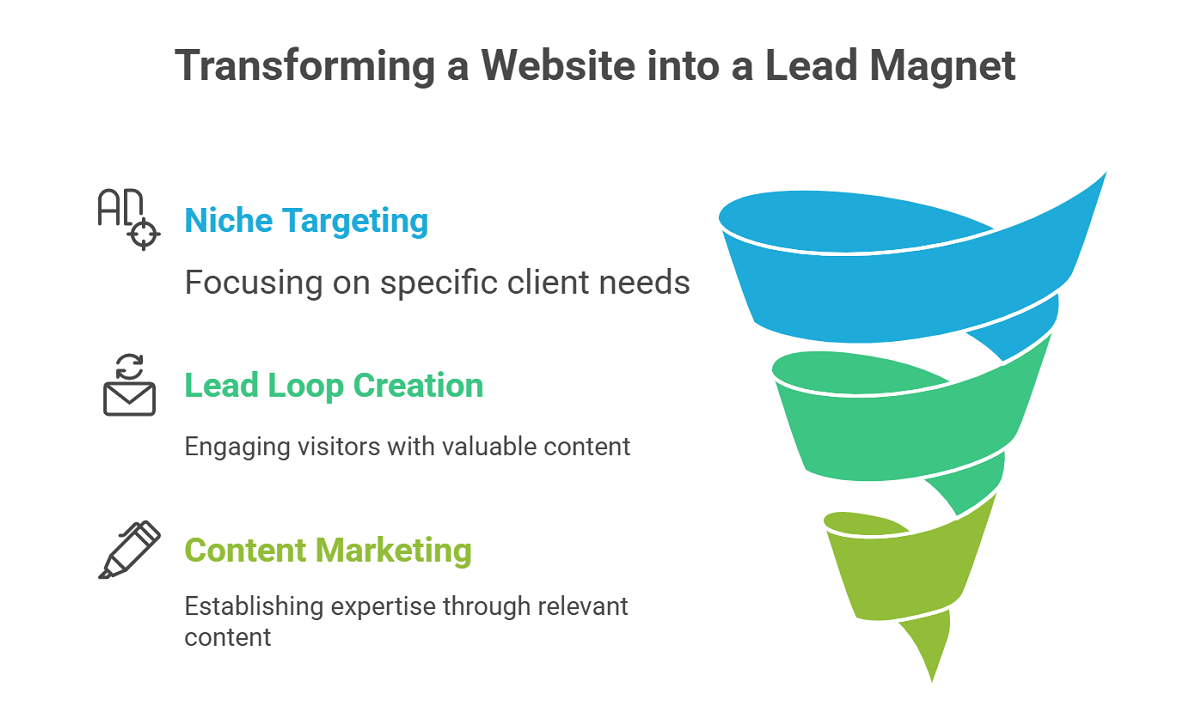
Step 1: Diagnose Your Site’s Gaps
Before you fix anything, you need to know what’s missing.
Here’s a quick self-check:
- Is your homepage speaking to a specific type of seller or buyer?
- Do you have clear, repeated CTAs that invite action?
- Is your website mobile-friendly and fast-loading?
- Can people in your area find you on Google?
- Are you publishing regular, helpful content?
If you’re missing 2 or more of those, don’t worry you’re not alone. But now you know what to change.
Step 2: Rebuild Around Your Dream Clients
Most agent websites are written for “everyone.” That’s the problem.
When you try to attract every buyer and seller in every market, your message gets diluted and people bounce.
Instead:
- Pick your niche: first-time sellers, upgraders, investors, downsizers, luxury… whatever fits your market.
- Rewrite your homepage and service pages around their needs.
- Use headlines like:
→ “Helping investors buy smarter in Brisbane”
→ “Helping young families sell with confidence in Sydney’s Inner West”
Narrowing your message actually widens your results.
Step 3: Build a Lead Loop (Not a Dead-End)
What happens after someone visits your site?
If the only path is “Contact me,” you’re losing leads who aren’t ready yet.
Here’s what a lead loop looks like:
- Homepage →
- “Download our free guide: 5 Things to Do Before Listing Your Home” →
- Visitor enters email →
- Email follow-up series with tips, blog links, listings →
- Trust builds over time →
- They book a call when they’re ready
Instead of hoping for a hot lead on the first visit, you’re staying top-of-mind until they’re ready.
Step 4: Let Content Keep You Visible
Your blog is more than an SEO tool, it’s your voice, your proof, and your follow-up.
But let’s be real: writing isn’t your zone of genius. You shouldn’t have to do it yourself but it does need to get done.
Content that drives listings:
- “What Your Home Is Really Worth in [Suburb] Right Now”
- “5 Mistakes That Cost [City] Sellers Thousands”
- “Should You Sell Before Buying? [City] Experts Weigh In”
This kind of content positions you as the expert even when you’re out showing homes or relaxing on a Sunday.
And when done right, it shows up on Google exactly when someone needs it.
How the Best Agents Are Winning Online (and Why It Feels Effortless)
Some agents look like they’re everywhere.
Their name pops up on listings, their site ranks in Google, their social media is polished, and somehow they’re still showing homes and closing deals.
How?
They’re not magical. They’re just using modern systems and strategic delegation to stay visible without burning out.
Here’s what they’re doing and how you can, too.

They Aren’t Writing Their Own Blogs
If you think top-producing agents are sitting down to write 1,000 words every week, think again.
They’re leveraging AI-powered content tools, human editors, and marketing teams that know their voice and know how to rank.
What this looks like:
- Weekly blog content without touching a keyboard
- SEO-optimized headlines based on actual search trends
- Calls-to-action built into every post
- Content scheduled and posted automatically
It’s not about outsourcing blindly, it’s about using the right blend of automation and real human strategy.
They Don’t Log Into Their Website Weekly But It Works Daily
Successful agents treat their website like a digital employee: working in the background 24/7, even when they’re offline.
The secret isn’t logging in more often, it’s building a system that runs without micromanagement.
Their site:
- Gets monthly SEO updates
- Is regularly checked for performance and speed
- Has updated listings and fresh CTAs
- Connects to an analytics dashboard so they know what’s working
- Aligns with their brand not some cookie-cutter template
It’s all handled and they’re focused on clients, not code.
They Don’t Try to Do Everything Alone
Here’s the biggest difference between agents who grow and agents who grind:
The ones who grow delegate smartly.
They stop DIY-ing everything. They stop trying to master SEO, content, and code.
Instead, they build a digital team even if it’s just one reliable partner and focus on what they do best: closing deals.
The Website Fix Roadmap
If your website isn’t getting you listings, it doesn’t mean you’ve failed.
It just means it’s time to rebuild with purpose.
Here’s the roadmap:
Your Website Should…
- Speak to your niche, not the masses
- Load quickly and look great on any device
- Guide visitors with clear CTAs and intentional structure
- Rank locally for search terms that matter (like “listing agent in [Your City]”)
- Publish weekly content that keeps you visible and trusted
- Work in the background while you work with clients in the foreground
And most importantly, your website should give you confidence.
Confidence that you’re showing up professionally.
Confidence that leads can find you.
Confidence that your site reflects the caliber of service you offer.
One Last Thought
You didn’t get into business to become a web designer, a copywriter, or an SEO specialist.
You got in to help people and to grow a business that supports your life.
If your website isn’t supporting you, it’s not doing its job.
You deserve more than a digital brochure. You deserve a site that brings in leads and lets you focus on closings.
Want more practical tips like this? Check out the real estate event in October we are sponsoring, or get in touch when you’re ready for a site that works while you work.