

Learning how to give better feedback as a leader strengthens performance and builds trust. Anchor conversations in specific, observable behavior, match your style to the task, and treat feedback as coaching, not evaluation.
Table of contents
- How to Give Better Feedback as a Leader: Why Traditional Approaches Fail
- The Science of Effective Feedback: Key Psychological Principles
- Task Context: Creative Growth vs. Prevention and Precision
- The Power of Causal Language
- Proven Frameworks for Delivering Constructive Feedback
- Mastering the Situation-Behavior-Impact (SBI) Model
- Shifting from Feedback to Feedforward
- Best Practices for Preparing and Delivering Difficult Conversations
- Building a Continuous Feedback Culture in Small Businesses
- Conclusion
- Frequently asked questions
- How do I give negative feedback without demotivating my team?
- What is the Situation-Behavior-Impact model in practice?
- Is the compliment sandwich a good technique?
- How soon after an event should I give feedback?
- How do I get honest upward feedback from my employees?
- What if my employee disagrees with my feedback?
For entrepreneurs and small business owners, stakes are higher: you work alongside your team daily, often without HR to mediate hard conversations. Harvard Business School Online advises being direct, citing specific behaviors, and connecting actions to business goals. This guide turns those principles into a system you can apply now.
How to Give Better Feedback as a Leader: Why Traditional Approaches Fail

Traditional feedback fails because it treats performance as an evaluation event rather than ongoing coaching. Annual reviews and vague compliments deliver delayed, generalized messages employees cannot act on. Columbia Business School notes feedback should come as close as possible to the event and describe behavior, not impressions of it: “you seemed bored” invites an argument; “you checked your phone during the pricing section” invites a conversation.
The praise sandwich is one of the most common feedback mistakes: burying a critique between generic compliments makes employees distrust positive comments, dilutes the corrective message, and signals manipulation, eroding psychological safety.
Poorly framed negative feedback triggers a threat response. Criticism attacking character pushes employees into self-protection: “you lack commitment” forces a defense of identity, while “the deliverable missed Friday’s deadline twice” keeps focus on the task.
Redefine feedback first: effective feedback is timely, specific, two-way information whose only purpose is helping a capable person do their best work.
The Science of Effective Feedback: Key Psychological Principles

What effective feedback shares across studies is specificity tied to the task: feedback on requirements, observed actions, and options improves performance more reliably than general evaluations. “You can still improve how you communicate” gives a new hire something to dread; walking through observed calls – praising the best, describing what happened when a customer struggled, offering alternatives – gives them something to rehearse.
The second pillar is perceived fairness: employees accept feedback when the process feels consistent, accurate, unbiased, and open to their input. Design it – same standards for comparable roles, correct information, bias-checking, and a voice for feedback recipients, who improve more sustainably when they can respond.
The third pillar is source credibility: expertise about the job, direct visibility of performance, and accurate measurement. In a small business this is often your advantage, since founders see the work firsthand – but unobserved corrections are speculation, and employees know it.
Task Context: Creative Growth vs. Prevention and Precision
Matching your feedback style to the work’s risk profile is an underused leadership skill. Promotion-focused work – creative campaigns, complex problem-solving – pursues positive outcomes; prevention-focused work – compliance, safety, financial accuracy – requires vigilance to avoid errors.
Negative feedback tends to impair creative performance while improving vigilance on precision tasks: critique in a brainstorm suppresses experimentation, while directness in a compliance review sharpens attention. Ask what the task needs: encouragement to explore, or precision to stop an error?
Pro tip
Before correcting, note the task type. For creative work, lead with strengths and feedforward; reserve direct correction for precision and risk-prevention tasks.
The Power of Causal Language
Using causal language means discussing why performance fell short – a shared investigation, not a verdict. Explaining the conditions behind an outcome helps the employee self-correct next time; without it, negative feedback lands as an unexplained judgment, producing defensiveness.
Try simple prompts: “The proposal missed the mark partly because we never clarified the client’s budget range. What would have helped you surface that earlier?” This names a cause, shares responsibility, and invites the employee into the solution.
Key takeaways
→ Specific, task-related feedback outperforms general performance evaluations because it tells employees exactly what to repeat or change.
→ Perceived fairness, including consistency, accuracy, and openness to employee input, drives whether feedback is accepted at all.
→ Negative feedback harms creative and exploratory work but can improve accuracy on precision and risk-prevention tasks.
→ Causal language turns a verdict into a shared diagnosis that employees can apply independently.
Proven Frameworks for Delivering Constructive Feedback
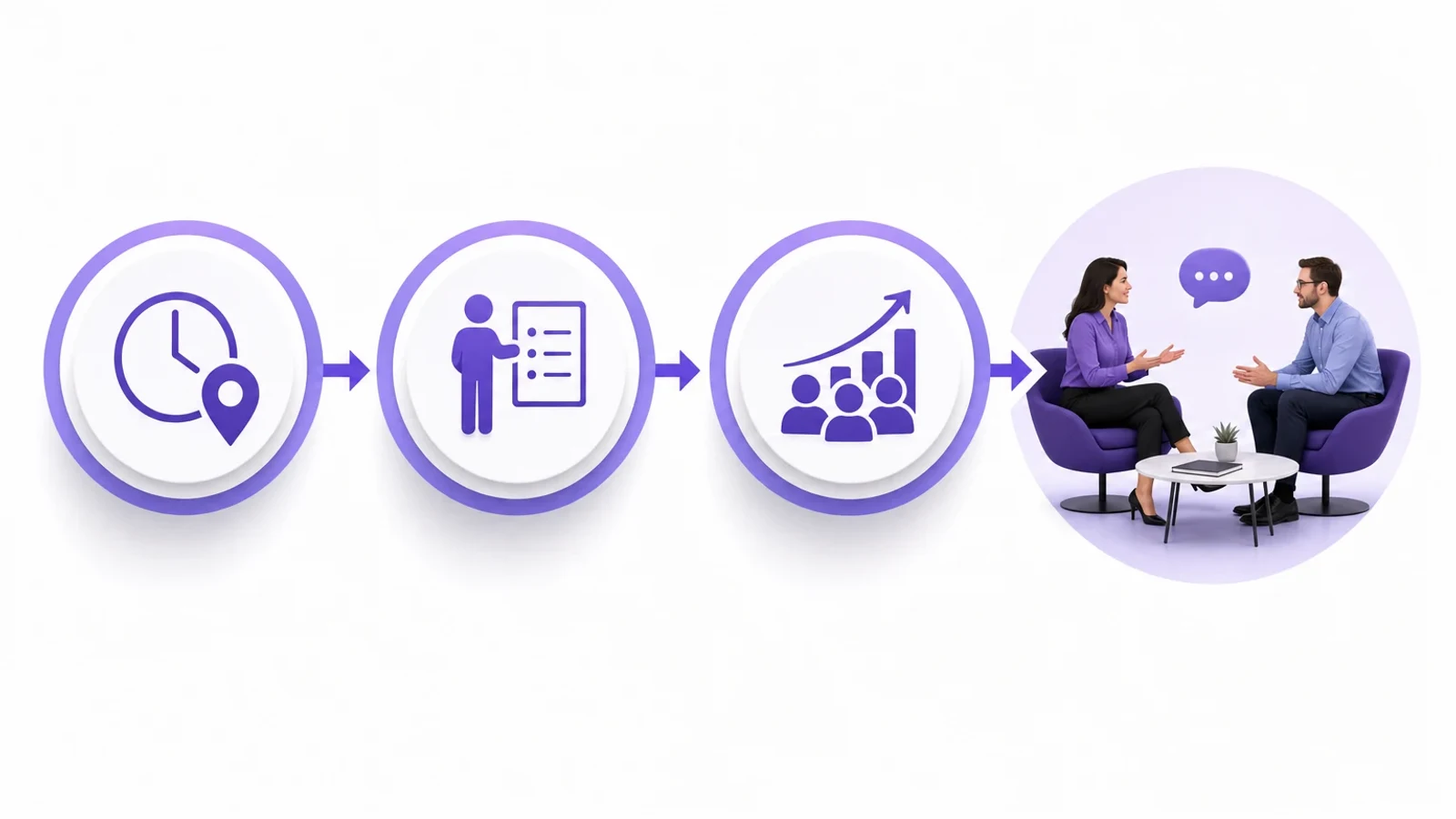
Frameworks prevent feedback drifting into generalities and character judgments. Three models cover most situations: Situation-Behavior-Impact for corrections, feedforward for development, and Nonviolent Communication for charged moments.
Mastering the Situation-Behavior-Impact (SBI) Model
SBI reduces ambiguity by separating judgments from observable data. Anchor three elements first.
- Situation: Name the exact time and place – “in yesterday’s kickoff call” – so they don’t assume a vague pattern.
- Behavior: Describe the observable action: “you interrupted the client three times” is verifiable; “you were rude” is a fightable conclusion.
- Impact: State the measurable effect and connect it to business goals: “we lost fifteen minutes of discovery, and she stopped sharing details” makes the cost concrete.
Compare “you need to work on your communication” with “in this morning’s standup, you cut Marcus off twice, and we missed two delivery risks. What got in the way?” Columbia Business School’s timing rule worth adopting: deliver it close to the event.
Shifting from Feedback to Feedforward
Feedforward replaces dissecting past mistakes with co-creating future success. The feed-forward interview starts with a recent positive episode, then identifies the conditions that enabled it – the employee’s “success formula.” Research links this approach to better performance ratings months later.
Use feedforward when defensiveness is high, when conditions rather than capability caused it, and when work is creative. After a failed launch, ask: “Tell me about the last launch that went well – what was different?” The answers reveal fixable process gaps criticism would never surface.
Nonviolent Communication handles emotionally loaded moments: observation, feeling, need, request. “When the report arrived two days late, I felt anxious about the renewal because I need predictability – can we agree on a pre-deadline check-in?” It keeps reactions honest without weaponizing them.
Warning
Don’t bolt feedforward onto an unaddressed serious problem: if someone underperformed on a precision-critical task, name it directly first. Feedforward is a development tool, not avoidance.
Key takeaways
→ SBI separates judgment from observation: name the exact situation, describe verifiable behavior, then state the concrete impact.
→ End every SBI conversation with an open question so the diagnosis becomes a two-way dialogue.
→ Feedforward interviews that reconstruct past success conditions have been linked to better performance ratings months later.
→ Nonviolent Communication’s observation-feeling-need-request sequence keeps charged conversations factual and actionable.
Best Practices for Preparing and Delivering Difficult Conversations
High-stakes conversations are won in preparation. Prepare in three phases: regulate yourself, design the environment, structure the dialogue. Skipping the first is costliest, because frustration leaks into your framing.
How to prepare and run a difficult feedback conversation
Check your own state first
Never deliver corrective feedback while angry or rushed. Ask yourself what you want the employee to do differently and what you want the relationship to look like afterward. If you cannot answer both calmly, schedule the conversation for later the same day or the next morning.
Verify your facts and your bias
Confirm you have direct observation of the performance, not secondhand impressions, and check whether the same standard has been applied to comparable team members. If your evidence is thin, gather specifics first; credibility collapses when your facts are guesses.
Script the SBI and the opening question
Write the situation, behavior, and impact in advance, then choose an opener that signals shared intent, such as “I want to talk about the timeline miss because I think we can fix the process together.”
Deliver, then genuinely listen
State your SBI in under a minute, then stop and ask “How do you see it?” Silence at this point is a tool; let the employee fill it. Their response tells you whether the gap is capability, clarity, or conditions.
Co-design the fix and set accountability
Agree on one or two specific changes, who owns them, and when you will follow up. Close by restating your confidence in the person and the connection between the change and their own goals.
Tip: Take brief notes during the conversation and send a three-sentence recap afterward. Written agreements prevent the most common failure mode of difficult conversations: differing memories of what was decided.
Psychological safety makes this work: employees take corrections without defensiveness when the conversation aims at a shared goal, not a personal verdict. Signal it through “we” framing and consistent fairness. Harvard Business School Online stresses being direct and speaking to the issue – itself an act of safety, since vagueness breeds anxiety.
Most leaders fall short on two-way exchange: if the employee cannot respond or contribute, it’s a monologue in feedback’s costume. Invite their read, expect to learn about your own management, and be visibly willing to change.
Building a Continuous Feedback Culture in Small Businesses
Individual skills matter less than the system around them. In a small business you set the norms personally: make feedback frequent, low-stakes, and bidirectional, so no single conversation carries a verdict’s weight.
Normalize micro-feedback in your existing rhythm: brief, specific observations during check-ins (“the way you handled that refund call saved the account”) cost seconds and compound. More frequent is not automatically better – what matters is that informal feedback is specific, timely, and task-anchored.
Role-modeling comes first. Ask for upward feedback explicitly and adjust visibly: “You told me my late-night emails created after-hours pressure – starting Monday, I’m scheduling them for 8 a.m.” Receiving criticism gracefully lowers the cost of honesty; bristling teaches the team to filter what reaches you.
Finally, align development with organizational growth: connect each person’s conversations to the capabilities the business needs next. Feedback tied to a visible future feels like investment, not surveillance. During goal-setting, ask what effective feedback would look like for them; it surfaces the style that lands best.
Best practice
Run a quarterly “process retrospective” where everyone, including you, names one thing to change – equal airtime builds safety fast.
Conclusion
Giving better feedback as a leader is a repeatable discipline: anchor conversations in specific behavior delivered close to the event, match your style to the task, use causal language to turn verdicts into shared diagnoses, and structure corrections with SBI – supported by fairness, credibility, and upward-flowing feedback.
Treat this as an ongoing program: practice one framework this week and ask one team member for upward feedback. Leaders whose teams improve fastest don’t avoid hard messages – their messages are specific, fair, and future-focused enough that people leave knowing what to do next.
Frequently asked questions
How do I give negative feedback without demotivating my team?
Check whether the task is creative or prevention-focused. For creative work, shift toward strengths-based feedforward. When negative feedback is necessary, use causal language to explore the gap, and anchor comments to specific behavior rather than character. On precision tasks, negative feedback delivered this way tends to sharpen performance.
What is the Situation-Behavior-Impact model in practice?
SBI structures corrective feedback in three parts: name the situation (“in Tuesday’s client call”), describe the behavior without judgment (“you interrupted her three times”), and state the impact (“we lost fifteen minutes of discovery”). Close with an open question inviting their perspective and a fix.
Is the compliment sandwich a good technique?
It’s risky and generally not recommended: burying a critique between layers of praise trains employees to distrust compliments and dilutes the message. Be direct instead, reserving genuine positive feedback for moments when it is deserved and unconnected to criticism.
How soon after an event should I give feedback?
As close to the event as you can while calm and prepared. Timely feedback prevents denial, but anger does more harm than a day’s delay. Regulate first, verify facts, then talk.
How do I get honest upward feedback from my employees?
Ask explicitly, act visibly, never punish it. Specific requests (“what one thing I do makes your job harder?”) outperform open invitations, and visibly adjusting after criticism teaches the team honesty is safe.
What if my employee disagrees with my feedback?
Treat disagreement as information, not insubordination. Ask them to walk you through their read and verify your observations. If your facts hold, restate them calmly and focus forward; if theirs are better, say so and adjust. Two-way exchange is what makes feedback feel fair.