

Real estate searches increasingly start in chat: buyers ask ChatGPT “Who is a strong listing agent near me?” and build shortlists from the answers. Zillow now runs an app inside ChatGPT surfacing real-time listings, so discovery already happens there. Independent brokerages can win citations for what portals answer poorly: hyper-local trade-offs, fees, and agent credibility.
Table of contents
- How ChatGPT Search Retrieves and Cites Content
- Generative Engine Optimization (GEO) vs. Traditional Real Estate SEO
- Technical Foundations: Ensuring AI Crawlers Can Access Your Site
- Configure robots.txt for AI Crawlers
- Prefer Server-Rendered or Static HTML
- Remove Lead Gates That Block Discovery
- Schema Markup for Real Estate Entities
- Content Architecture for ChatGPT Real Estate Search
- Replace Puffery with Extractable Facts
- Design Question-Led FAQs for Direct Answers
- Build Authoritative Neighborhood Guides
- The ‘Single Source of Truth’ Framework for Local Real Estate
- Off-Page Entity Signals and Third-Party Corroboration
- Align NAP+L Across Every Profile
- Secure High-Density Client Reviews
- Build Digital PR Mentions
- How to Make a Real Estate Business Appear in ChatGPT Search: Measuring Visibility
- ChatGPT Visibility FAQ
- Can I guarantee my real estate business will appear in ChatGPT answers?
- Should I allow GPTBot or only OAI-SearchBot in robots.txt?
- Does schema markup alone make my brokerage visible in ChatGPT?
- How do Zillow listings interact with ChatGPT search?
- How long does it take to see results from AI search optimization?
- What is the single highest-impact first step?
- Conclusion
This guide explains how to make a real estate business appear in ChatGPT search: allow AI crawlers, publish structured factual content, keep your entity consistent, and measure AI visibility separately.
How ChatGPT Search Retrieves and Cites Content
ChatGPT search combines pre-trained knowledge with real-time retrieval. OpenAI’s OAI-SearchBot indexes content for ChatGPT search, distinct from GPTBot, which trains models. Without OAI-SearchBot access to your pages, you cannot be cited in real time – unlike Google’s AI Overviews, which lean on the existing search index.
An answer engine assembles responses rather than listing links, so it prioritizes extractable passages. “I’m the top-producing agent in town” gives the model nothing to quote; “In [city], sellers typically pay 1 to 3 percent in closing costs” is a direct answer it can cite. ChatGPT also cross-references your license, brokerage, and service area against public profiles.
Generative Engine Optimization (GEO) vs. Traditional Real Estate SEO
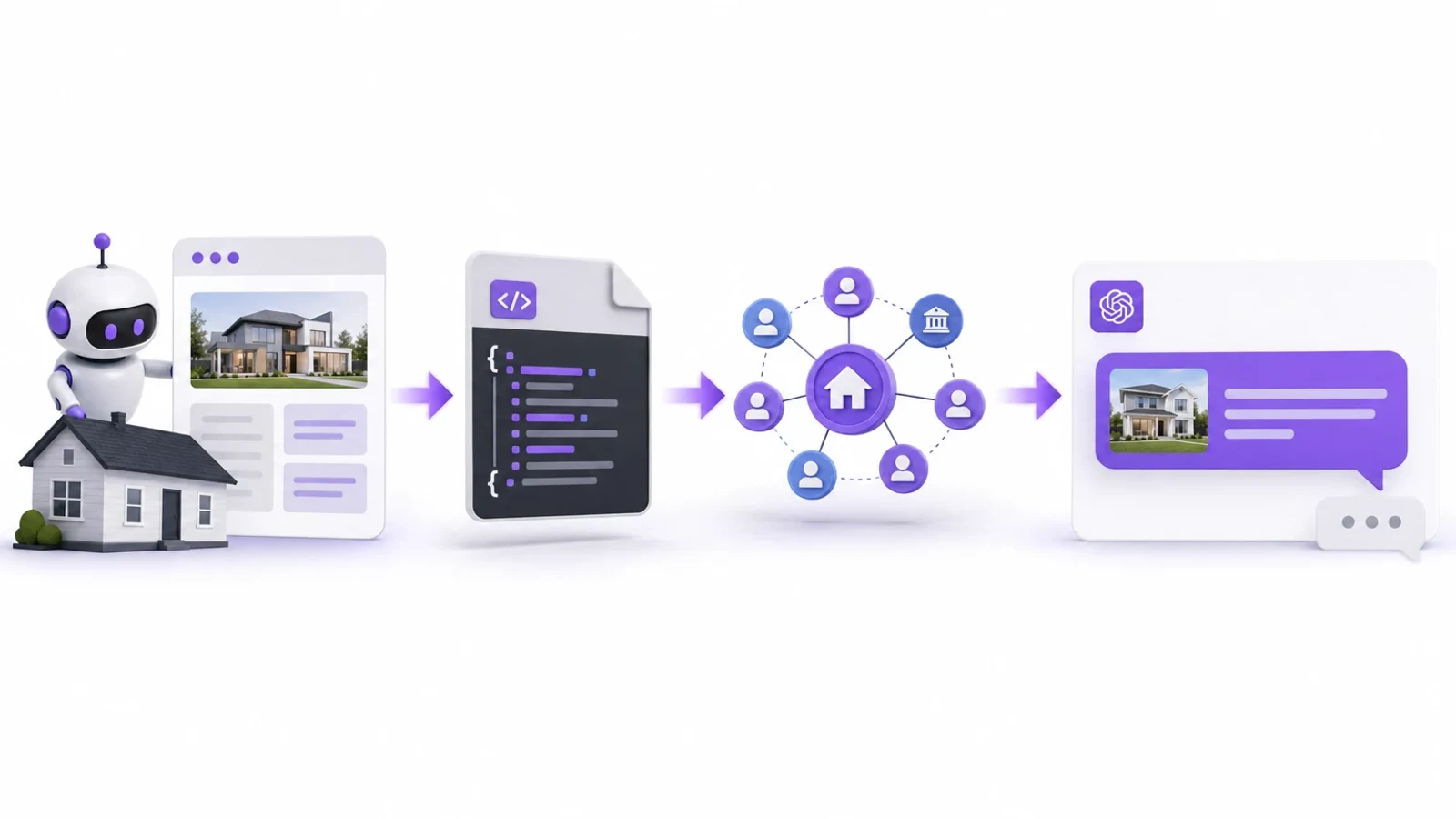
Traditional SEO for real estate optimizes for rankings and clicks; Generative Engine Optimization (GEO), sometimes called Answer Engine Optimization, optimizes for citation likelihood. Google rewards relevance and authority; answer engines reward clarity, extractability, and corroboration.
A peer-reviewed study of 1,508 German real estate agencies found agents with FAQPage schema were far more likely to be visible to ChatGPT (6.2 percent of visible agents versus 0.8 percent), and Product schema correlated strongly too (17.2 versus 1.8 percent). Visible sites were also more often mobile-friendly with structured headings. The authors caution this is correlation, not causation, but retrieval clearly favors clean structure and machine-readable facts.
Models also weigh verifiable credentials: license numbers, affiliations, and third-party mentions. Our guide to real estate search engine optimization covers the traditional and AI layers together.
Key takeaways
→ ChatGPT combines pre-trained knowledge with real-time retrieval powered by OAI-SearchBot, so crawlability is the entry ticket.
→ FAQPage and Product schema showed the strongest statistical association with ChatGPT visibility in a study of 1,508 agencies.
→ GEO optimizes for citation likelihood, not keyword rankings: entity clarity and extractable facts matter most.
Technical Foundations: Ensuring AI Crawlers Can Access Your Site
Before content strategy matters, AI crawlers must reach your pages. Three issues block most real estate websites: restrictive robots.txt rules, JavaScript-dependent rendering, and lead-capture gates.
Configure robots.txt for AI Crawlers
Confirm robots.txt does not disallow OAI-SearchBot. Perplexity documents PerplexityBot for indexing and Perplexity-User for user-directed fetches, so review both. GPTBot, which trains models, is a separate decision.
Prefer Server-Rendered or Static HTML
Server-side rendering or static HTML is the most reliable baseline because full text arrives without JavaScript. Many IDX platforms render listings client-side, leaving crawlers an empty shell. Test key pages without a browser: neighborhood names, prices, and services should appear in the raw source.
Remove Lead Gates That Block Discovery
Forced-registration modals hide inventory and market data from bots. Keep neighborhood guides and market statistics open; gate only premium reports. If your site is sound but underperforming commercially, see our article on why a website may not be generating leads.
Schema Markup for Real Estate Entities
JSON-LD structured data tells machines what your pages describe. Implement these types where they match visible content:
- RealEstateAgent or Organization: Name, license number, service area, contact details, and brokerage.
- FAQPage: Mark up Q&A blocks on cost, process, and neighborhood pages; this schema showed the strongest association with ChatGPT visibility in the German study.
- Product or Offer schema: Apply to listings and service pages; it also correlated strongly with visibility.
- sameAs connections: Link your entity to your licensing portal, Google Business Profile, and directories.
Treat schema as an accuracy layer, not a ranking guarantee. OpenAI notes that claiming a business profile lets eligible businesses contribute current information, but claiming does not guarantee placement or sales.
Pro tip
Validate every schema block with Google’s Rich Results Test, and ensure markup describes content visitors can see; hidden-content markup undermines trust.
Key takeaways
→ Audit robots.txt first: OAI-SearchBot must be allowed for ChatGPT search retrieval.
→ Static or server-rendered HTML beats JavaScript-rendered listing data for AI indexing.
→ Keep market data ungated; reserve lead capture for premium reports and consultations.
→ Implement RealEstateAgent, FAQPage, and Product schema with sameAs links to licensing and profile pages.
Content Architecture for ChatGPT Real Estate Search

Once crawlers can reach your site, content determines citation. Answer engines reward pages that answer real questions rather than sell services: factual, high-density information organized around what buyers and sellers actually ask.
Replace Puffery with Extractable Facts
Superlatives give a model nothing to cite; concrete data does. Build pages with local closing cost percentages, staging cost ranges, days on market by subdivision, HOA fees, and transfer taxes, presented in labeled tables and short paragraphs. When pages compete, models favor the clearest, most current passage.
Design Question-Led FAQs for Direct Answers
Use the exact question a buyer would type as your heading, such as “How much are closing costs when selling a home in Des Moines?” Answer in 40 to 70 words of plain language, then add local context. Mark each pair with FAQPage schema and keep visible copy aligned with the markup.
Build Authoritative Neighborhood Guides
Thin pages copied from MLS descriptions get skipped. A first-hand neighborhood guide covers housing stock, zoning, schools, commutes, flood zones, and honest trade-offs. Original photos and a named author add verifiable expertise – what an answer engine looks for.
The ‘Single Source of Truth’ Framework for Local Real Estate
Each recurring question class deserves one authoritative page rather than ten thin posts. Map specific pages to the questions your market generates:
- “Who is a strong listing agent in [neighborhood]?” One agent page with license details, service area, specialties, and attributed reviews.
- “What is it like to buy or sell in [neighborhood]?” One maintained neighborhood page with trade-offs, housing stock, and market facts.
- “What happened in the [market] housing market?” One dated report showing the window, data source, and last-reviewed date.
- “What does this service cost?” One seller cost page with scope, exclusions, and process.
Publish methodology-backed market updates on a fixed schedule, because AI systems favor current information. A well-structured page serves Google and ChatGPT simultaneously; you do not need separate “AI versions.”
Warning
Do not generate a page for every city or ZIP code. Multi-location brands often template city pages; instead, create local pages only when first-party evidence, such as repeated client questions or Search Console queries, shows genuine demand. Thin pages dilute authority.
Off-Page Entity Signals and Third-Party Corroboration
ChatGPT cross-references your identity and credibility across the open web before recommending real estate agents, making off-page entity consistency core to AI visibility.
Align NAP+L Across Every Profile
Your Name, Address, Phone, and License data should match exactly across your Google Business Profile, Zillow, Realtor.com, chamber listings, and website. Even “Suite 200” versus “Ste. 200” can confuse AI systems merging records. Resolve conflicts rather than creating duplicates, and keep your website as the source of truth.
Secure High-Density Client Reviews
“Great agent!” carries no informational weight. “Sold our townhouse under $400,000 in 12 days and negotiated $15,000 above asking” gives an answer engine verifiable detail. Ask clients to mention neighborhood, price point – first-time buyers under $300k, move-up sellers – and timeline. Never buy or copy reviews; AI systems cross-check patterns, and fake signals can suppress visibility.
Build Digital PR Mentions
Quotes in local news and guest commentary on housing trends create the third-party corroboration answer engines seek; relevant sources like a trusted local outlet often outweigh a dozen self-published posts. Ensure quoted details, such as title and brokerage, match your core entity data.
Best practice
Run a quarterly entity audit: search your business name and license number, compare every profile against your website, and fix discrepancies promptly.
How to Make a Real Estate Business Appear in ChatGPT Search: Measuring Visibility
AI search visibility produces four distinct signals. Separate crawler access, AI referral traffic, citations, and traditional search performance so you can tell which layer is improving.
How to set up AI visibility measurement
Track ChatGPT referrals in Google Analytics 4
ChatGPT search links include utm_source=chatgpt.com, so build a GA4 exploration filtered on that referral source to count human sessions arriving from ChatGPT answers and see which pages they land on.
Review Bing Webmaster Tools AI Performance reports
Bing provides AI Performance reporting that details citations, cited pages, and sampled grounding queries across Microsoft-powered AI surfaces. Note that citation counts do not indicate rank or page importance, and grounding queries are sampled, so treat these as directional signals.
Monitor crawler hits in server logs
Check verified server or CDN logs for OAI-SearchBot and PerplexityBot requests to confirm your key pages are being fetched successfully. A crawler hit is an access signal, not proof of a citation.
Run a controlled visibility test
Pick one or two pages with measurable search demand, record a baseline, improve answer structure and evidence on those pages only, and freeze at least three comparable pages as controls. Review treated-versus-control changes weekly for six weeks across Google impressions, AI referrals, and citations.
Tip: If citation and referral volume are too small to interpret, do not manufacture a win. Keep the low-cost foundation in place and wait for a larger sample.
Because ChatGPT answers may mention your brand without a click, pair automated tracking with a fixed monthly question list tested in ChatGPT, Perplexity, and Gemini. Our guide on how to improve website rankings on Google explains how traditional and AI signals reinforce each other.
ChatGPT Visibility FAQ
Can I guarantee my real estate business will appear in ChatGPT answers?
No. OpenAI states ChatGPT makes independent AI recommendations, and claiming a profile does not guarantee placement or sales. Allowing OAI-SearchBot is a prerequisite for retrieval, but placement depends on content quality, corroboration, and competition.
Should I allow GPTBot or only OAI-SearchBot in robots.txt?
OAI-SearchBot powers ChatGPT search retrieval and should be allowed if you want citations. GPTBot supports potential model training – a separate decision many brokerages make independently.
Does schema markup alone make my brokerage visible in ChatGPT?
No, but it helps. The study of 1,508 German real estate agencies found FAQPage and Product schema were the strongest positive predictors of ChatGPT visibility, though correlation is not causation. Schema works alongside crawlability, factual content, and entity consistency.
How do Zillow listings interact with ChatGPT search?
Zillow’s app inside ChatGPT surfaces real-time listings when users invoke it. Some discovery therefore stays in the portal ecosystem, making your own ungated neighborhood and market content more important for direct citations.
How long does it take to see results from AI search optimization?
There is no fixed timeline. Technical fixes like robots.txt and schema can take effect within weeks, while citation lift from content and entity work typically requires a sustained quarterly program. Run controlled tests over at least six weeks.
What is the single highest-impact first step?
Quick answer: audit robots.txt to confirm OAI-SearchBot is not blocked, then verify key pages return full text in raw HTML without JavaScript. These checks remove the most common barriers to AI retrieval.
Conclusion
Appearing in ChatGPT search compounds crawlable architecture, factual content, consistent entity data, and disciplined measurement. Allow OAI-SearchBot, render pages in static HTML, build single-source-of-truth pages for your market’s questions, align your name, address, phone, and license everywhere, and cultivate specific reviews and press mentions. Track AI referrals, citations, and crawler access separately each quarter. Real estate brands that commit to this system earn recommendations where buyers and sellers build their first shortlist.